
How to choose the right LED lamp

Faced with the wide selection of LED lamps in store, it can be difficult to know which one to choose. Read what to compare on the packaging so you can find the LED lamp that best suits your needs.
Buying LED lamps is different from what many people are used to. When purchasing incandescent bulbs, you only needed to choose the correct wattage and perhaps decide between a frosted or clear bulb. With LEDs, the wattage only indicates the lamp’s low energy consumption. By replacing your old bulbs with LEDs, you will noticeably reduce your electricity bill.
When comparing LED lamps, the most important information is the colour temperature (kelvin, K) and the light output (lumen, lm). The most common bulb shapes and caps are available for each kelvin and lumen value, so it is essential to compare these two values first and only then select the correct bulb shape and cap.
In stores, Airam lamps are grouped according to light colour temperature, i.e. kelvin (K).
1. First look at kelvin – the tone of the light
Start by considering what shade of light you want. Kelvin (K) indicates the tone of white light. The lower the value, the warmer the light. The colour of light affects not only how interior colours, textiles and objects appear, but also alertness and performance. For home use, choosing the shade of light is largely a matter of preference – there is no absolute right or wrong choice.
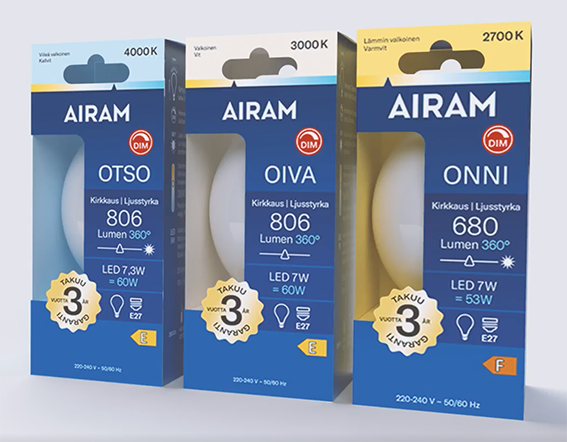
For general lighting, neutral white light of around 3000 K is suitable. At Airam, these general lighting lamps are called Oiva LEDs.
For more atmospheric or softer lighting, choose a warmer tone. LEDs with a colour temperature of 2700 K are Onni LEDs.
For task lighting or as general lighting in a light and modern home, cool white 4000 K Otso LED is suitable. The kelvin value is shown both numerically and in text at the top of the package and is also clearly colour-coded on the front of the packaging.
2. Next, check the lumens – the brightness of the lamp
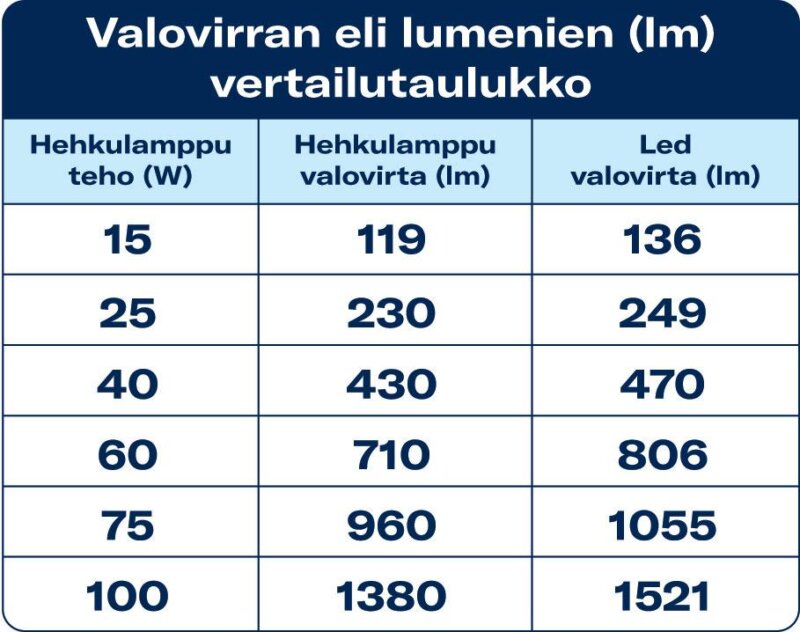
Lumen indicates the lamp’s light output, i.e. how strong the light is. On Airam packaging, the lumen value (lm) is clearly shown both as a number and as a slider scale. If you are looking for light equivalent to a 60 W incandescent bulb, choose an LED producing approximately 806 lm.
3. Finally, choose the right bulb shape and cap
It might seem logical to start by selecting the correct bulb shape and cap, but with LEDs you should focus on these last. On the shelf, the most common shapes and caps are available for each kelvin and lumen value. Once you have found the right section with suitable values, you can then choose the LED that best suits your purpose.
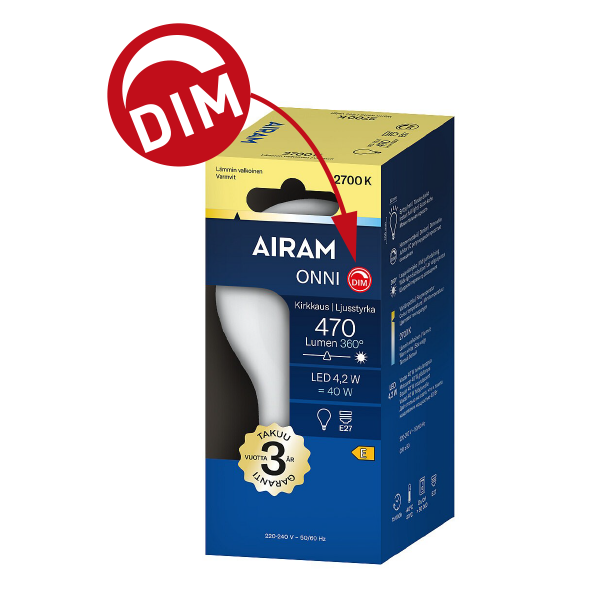
DIM symbol indicates a dimmable LED lamp
If you are looking for a dimmable LED lamp, look for packaging marked with a red DIM symbol. Remember that you need an LED-compatible dimmer. Old dimmers designed for incandescent or halogen lamps may not work properly with LEDs.
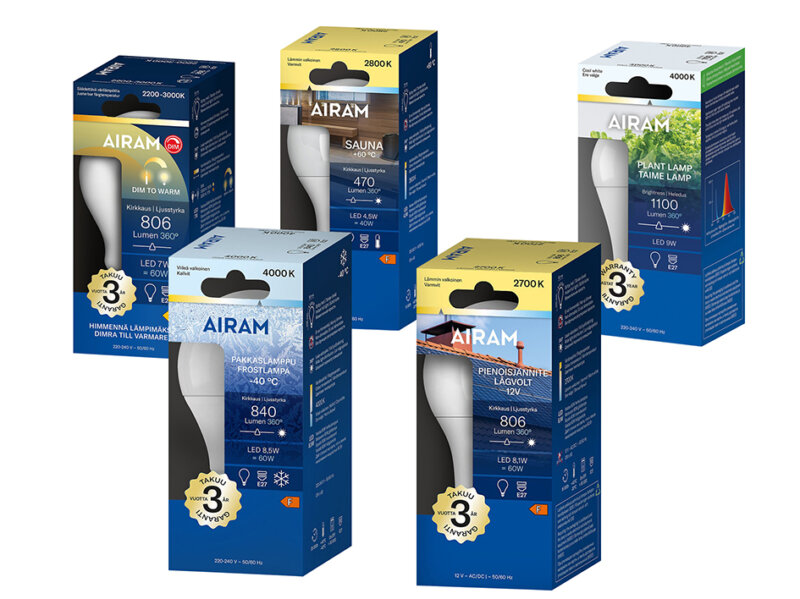
Special LEDs for specific needs
In addition to LEDs for general lighting, there are specialist lamps such as plant lamps, 12 V low-voltage lamps for solar systems, frost-resistant LEDs for outdoor use and cold environments, and more. Airam specialist LED packaging clearly stands out from general lighting products, as their intended use is highlighted with images and illustrations.
A broken LED lamp belongs in WEEE recycling
When an LED lamp breaks, it must not be disposed of with general household waste but taken to WEEE recycling. LED lamps contain electronic components. Recycling is free of charge. You can easily find your nearest collection point at your local shop.